
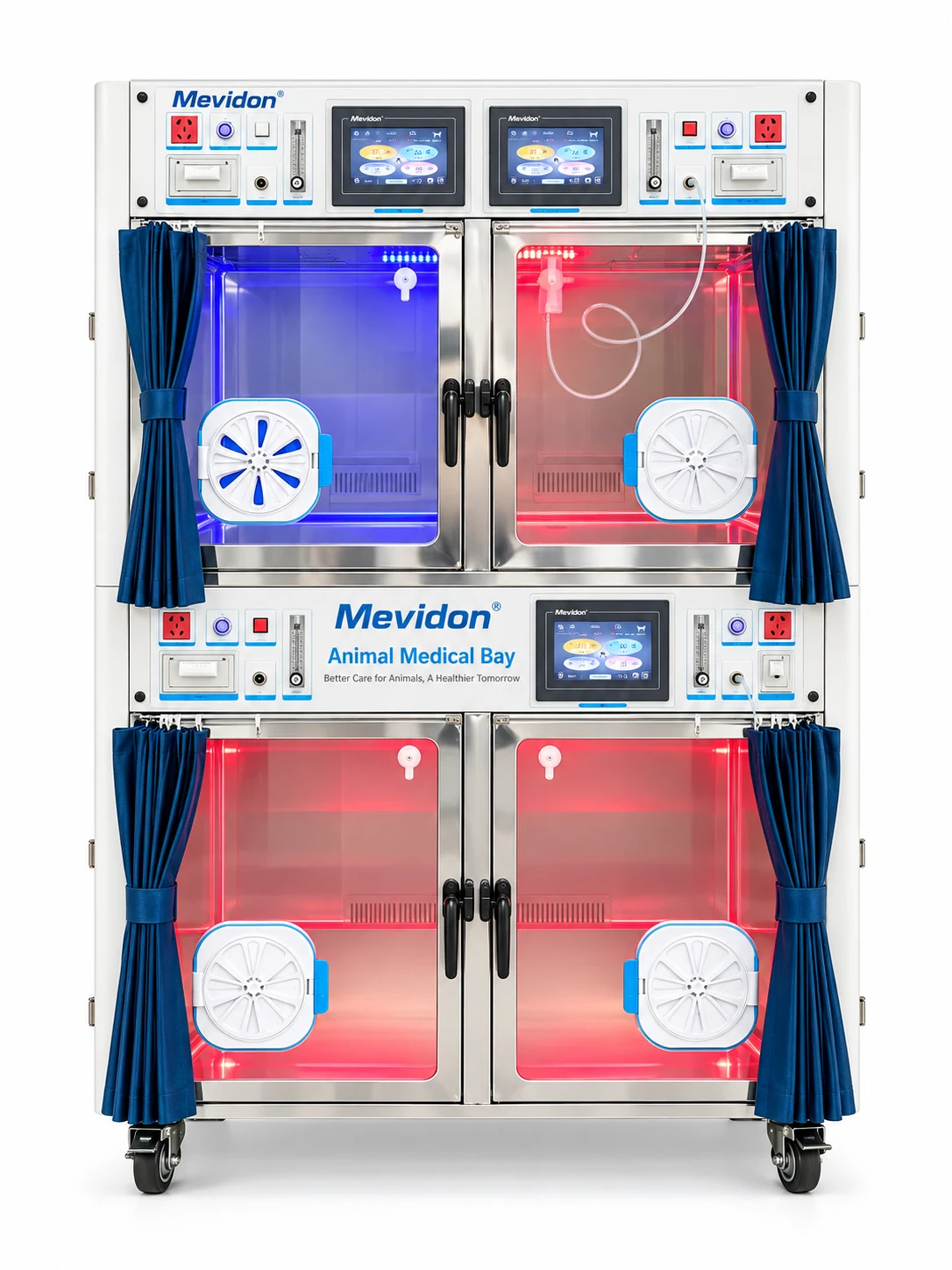
Choose a veterinary oxygen cage around the patients you treat and the controls your team can supervise. Verify the usable chamber size, oxygen-source compatibility, concentration monitoring, airflow, temperature and humidity management, cleaning access, alarms, service plan, and model-specific documents before ordering.
A veterinary oxygen cage can provide a controlled, low-handling environment for animals that need supplemental oxygen during respiratory care, post-anesthetic recovery, cardiac support, or emergency stabilization. Unlike masks or nasal interfaces, an enclosed chamber may allow a stressed patient to rest while clinicians monitor both the animal and the chamber environment.
The correct system is not determined by one headline specification. Patient size, expected case load, oxygen source, room ventilation, environmental controls, cleaning workflow, staff training, and local requirements all affect the final configuration. This guide follows the supplied buying framework while treating numerical performance and regulatory status as model-specific items that must be confirmed in current documentation.
What Is a Veterinary Oxygen Cage and How Does It Work?
A veterinary oxygen cage is an enclosed chamber designed to support controlled oxygen therapy for dogs, cats, and selected other small animals. It connects to a compatible oxygen supply while the chamber system manages circulation and, depending on configuration, may also support ventilation, dehumidification, temperature control, and continuous environmental display.
The clinical goal is to maintain the prescribed environment without frequent door opening or unnecessary restraint. Because opening the chamber changes oxygen concentration and climate, staff should assess the patient through transparent panels and use the installed monitoring functions according to veterinary protocols.
Available concentration ranges, recovery time after door opening, carbon-dioxide management, air-exchange design, and alarm behavior vary by model. Ask the supplier to document these items for the exact configuration under consideration.
Core Benefits of a Professional Veterinary Oxygen Cage
Stable, adjustable oxygen support
Integrated monitoring and controlled oxygen input can help clinicians maintain a selected treatment range. The source material references configurations from ambient concentration up to 80%; verify the supported range, sensor accuracy, response time, and calibration method for the quoted model.
A lower-handling recovery environment
For patients that do not tolerate a mask or nasal interface, an enclosed transparent chamber can reduce repeated handling and make visual observation easier. Noise performance is configuration-specific, so request measured operating-noise data when a quiet ICU environment is important.
Environmental monitoring in one workflow
Selected systems combine oxygen display with temperature, humidity, airflow, and ventilation functions. Confirm which parameters are actively controlled, which are monitored only, and what happens if a value moves outside the set range.
More consistent staff workflow
Once correctly configured, a cage can support continuous therapy without manual restraint. It does not replace clinical observation: define responsibility for patient checks, chamber readings, door-opening events, cleaning, and emergency removal.
Separation between patients
An individual chamber can support physical separation in the ward. Infection-control performance still depends on cleaning, disinfection, airflow design, filters, room procedures, and the pathogen involved; a sealed chamber should not be treated as a universal infection-control guarantee.
Common Clinical Applications for Veterinary Oxygen Cages
Veterinary teams may consider oxygen cages for respiratory support, post-surgical and anesthetic recovery, cardiac patients, trauma or shock workflows, smoke-inhalation cases, and selected elderly or debilitated animals. The attending veterinarian should determine oxygen concentration, duration, monitoring, escalation, and contraindications for each patient.
Respiratory disease support
Patients with pneumonia, bronchial disease, upper-airway disease, or other causes of breathing difficulty may benefit from a controlled oxygen environment when clinically indicated.
Post-surgical and anesthetic recovery
A cage can support recovery workflows when a patient requires supplemental oxygen and minimal handling. Monitoring plans should cover ventilation, oxygenation, temperature, consciousness, and readiness to leave the chamber.
Cardiac and emergency care
For selected cardiac, trauma, smoke-inhalation, or shock cases, an oxygen cage may form one part of stabilization. It should be integrated with the clinic’s diagnostic, monitoring, medication, and escalation protocols.
Key Features to Check Before Buying a Veterinary Oxygen Cage
- Oxygen concentration precision and stability. Request the adjustable range, sensor type, accuracy, calibration interval, recovery after door opening, and alarm thresholds.
- Operating noise. Ask for measured data and the test condition rather than relying on a generic “silent” description.
- Full visual access. Transparent, durable panels should allow patient observation while supporting the chamber’s cleaning and sealing requirements.
- Temperature and humidity management. Confirm the working range, sensor location, control method, condensation management, and alarm behavior.
- Cleaning and disinfection. Review surface joints, removable parts, filter access, compatible disinfectants, drying instructions, and turnaround time between patients.
- Door security and pressure balance. Check the latch, seals, pressure-relief design, emergency opening, and safeguards against accidental patient escape.
Documents to request with the quotation
- Model and chamber dimensions
- Oxygen-source requirements
- Environmental-control ranges
- Alarm and safety descriptions
- Cleaning and maintenance instructions
- Destination-market documents
Portable vs. Clinic ICU Veterinary Oxygen Cage
| Comparison | Portable oxygen cage | Clinic ICU oxygen cage |
|---|---|---|
| Typical use | Basic or occasional oxygen-support workflows | Higher-acuity or repeated hospital use |
| Installation | Compact and easier to move, depending on oxygen source | May require site planning, commissioning, and training |
| Controls | Usually a simpler feature set | May integrate oxygen, climate, ventilation, display, and alarms |
| Procurement focus | Portability, chamber size, setup, and basic monitoring | Control precision, workflow, service, documentation, and total ownership cost |
Veterinary oxygen cage price planning
Price depends on chamber size, oxygen-control architecture, monitoring, temperature and humidity functions, ventilation, materials, alarms, accessories, documentation, delivery, installation, training, and service. Compare entry-level portable, mid-standard clinical, and high-end ICU configurations by the included scope—not the equipment label alone.
CE, FDA, ISO 13485, or other regulatory references are not universal product guarantees. Ask for the exact certificate, registration, manufacturer scope, model coverage, intended-use wording, and destination-market applicability before purchase.
Frequently Asked Questions About Veterinary Oxygen Cages
Is a veterinary oxygen cage suitable for both dogs and cats?
Veterinary oxygen cages are commonly configured for dogs, cats, and selected other small animals. Confirm the chamber size, patient-weight guidance, airflow, observation access, and intended use for the exact model before treatment.
How long can a pet stay inside a veterinary oxygen cage?
Treatment duration depends on the patient, clinical objective, oxygen concentration, temperature, humidity, carbon-dioxide control, and veterinary supervision. Follow the attending veterinarian’s protocol and the selected model’s instructions rather than relying on a universal time limit.
Does a veterinary oxygen cage require professional installation?
Requirements vary by configuration. Some systems connect to a compatible oxygen source with straightforward setup, while integrated ICU configurations may need site planning, commissioning, training, and checks by qualified personnel.
How should a veterinary oxygen cage be cleaned and maintained?
Use disinfectants and contact times approved for the chamber materials, clean between patients, dry and ventilate the chamber, inspect seals and filters, and follow the manufacturer’s calibration and preventive-maintenance schedule.
Choose a configuration for your hospital
Send your oxygen-cage requirements to Mevidon.
Share your patient sizes, clinical workflow, expected case volume, destination country, oxygen source, environmental-control needs, and required documents. Mevidon can prepare a configuration for review as a veterinary equipment manufacturer and one-stop supplier.